

Artificial Intelligence is rapidly reshaping the workplace and public health experts are making sure their field is ready.
During the 14th Annual Public Health Conference, held on Thursday, Oct. 23, at the University of Georgia Center for Continuing Education and Hotel, a panel of experts spoke about how the public health workforce can prepare for AI in the workplace, including how to start slow, use it responsibly, and how to overcome anxiety about its implementation.

AI adoption consultant, and UGA assistant professor, Dr. Tyler Wallace, shared results from a Microsoft survey conducted last year, wherein two-thirds of managers said they would not hire someone who didn’t have AI skills. As the number of AI users grow, Wallace said this skillset is becoming a part of the evolving workforce.
“One tool has 800 million users in less than three years,” Wallace said. “We’ve never seen adoption like this before.”
Wallace, the creator of an AI Certification Program for rural healthcare practitioners, stressed the importance of preparing students and leaders to guide their teams and organizations in AI adoption.
“Invest in training,” added assistant professor Kelly Johnson. “If we’re concerned about using AI responsibly, the best way to jump in and learn, is using someone who understands those regulations and how to use it responsibly.”
Johnson cited a Pew Research Center study of 28,000 individuals, which found that 76% of individuals were “more concerned than excited” or “equally concerned and excited” about using AI in their daily work. She acknowledged the worry for AI replacing jobs, but highlighted that it can’t replace human connection, or a sense of belonging that is in a workplace.
Master of Health Administration (MHA) student, Maddox Shook, shared how he used AI in his internship at Coffee Regional Medical Center. He was first introduced to AI in his Health Informatics class and found small and practical ways to incorporate AI in his work.
“One of my first big projects was helping merge multiple workplace violence policies into one, and normally that would have taken several days of formatting, editing, and dictating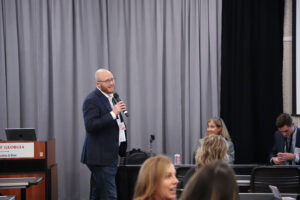 things,” said Shook. “But with AI, I would say able to do it in a few short minutes.”
The session aimed to help students and leaders overcome anxiety, emphasized its role in the public health workforce and explain how it should be used responsibly. Johnson urged the audience to start small, invest in training, and explore practical uses for it to drive real impact for their work.
By Somaiya Curwen


